Introducing B cell Llama™
Delivering for what the bispecific, multispecific & CAR-T discovery era needs
Single-domain camelid antibodies with native epitope access and function-based selection, rather than binding affinity alone, and without relying on conventional chain-pairing engineering workarounds.
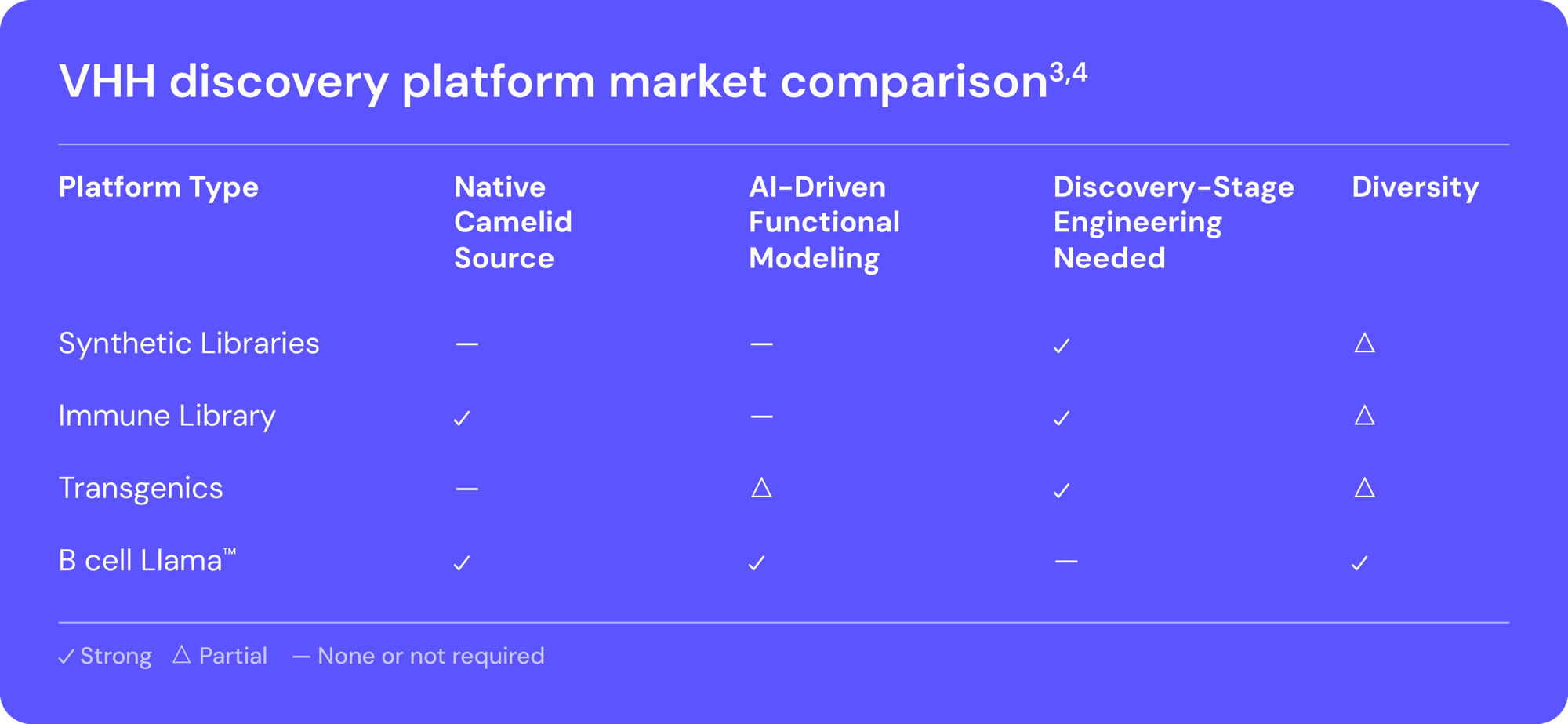
A fundamentally different approach to VHH discovery:
By Method
Directly isolated from immunized llamas, not constructed in vitro.
Derived via proprietary antigen-specific selection—without synthetic libraries or display-based selection. This approach is designed to avoid certain diversity bottlenecks, including cloning, transformation, and bacterial growth. B cell Llama accesses antibodies at the source—no synthetic library construction, display scaffold, or panning required.
By Nature
Derived from in vivo, matured immune response.
Camelid in vivo maturation yields highly diverse, affinity-matured VHH repertoires through somatic hypermutation and antigen-driven selection. The result: target-specific single-domain antibodies with stability advantages that can access challenging epitopes in a natural context, without conventional chain pairing or discovery-stage library engineering constraints.
By Function
Functional activity is not determined by affinity alone.
LensAI™ prioritizes candidates based on functional activity, not binding strength alone, addressing a documented gap in conventional screening. Binding affinity alone does not reliably predict functional activity,¹ and affinity-first selection can contribute to downstream candidate selection and development risk.²
B cell Llama builds on our established B cell Select® platform, designed to deliver highly diverse repertoires, functional activity, and strong binding affinity. Every campaign is designed around the optimal camelid species to support a strong immune response for your program. Across MindWalk’s discovery technologies, we have supported 15+ client molecules advancing to clinical trials.
Talk 1:1
with the
team
Connect with a team of scientific and technology experts.
1. Le, D.H.T. et al. Biomacromolecules (2026). https://doi.org/10.1021/acs.biomac.5c02042 2. Brooks & Abdiche, Drug Discovery Today, 2014 3. Comparisons reflect MindWalk’s characterization of typical VHH discovery platform categories based on publicly available information, peer-reviewed literature, and MindWalk platform documentation, and may vary by provider, workflow, target, and implementation. Strong indicates a characteristic generally associated with the platform category or core workflow. Partial indicates the characteristic may apply depending on provider, workflow, target, or implementation. None or not required indicates the characteristic is not generally inherent to, or not required for, the relevant workflow. Discovery-Stage Engineering Required reflects whether each platform requires in vitro library construction, phagemid cloning, biopanning, display scaffolding, or germline modification before functional hit identification. 4. Arbabi-Ghahroudi et al. (2009). PMC2546978; Maas et al. Nature Communications (2024). https://doi.org/10.1038/s41467-024-48735-x